
Wayne County Genealogy Records
Wayne County genealogy records present a research challenge because two courthouse fires destroyed many of the earliest documents. The first courthouse burned on February 9, 1853, and a second fire followed on April 9, 1892. Despite those losses, records at the Recorder of Deeds and Circuit Clerk go back to 1818 for land records, 1853 for marriage records, and 1819 for court records. Wayne County was organized on December 11, 1818, from Cape Girardeau and Lawrence Counties, and was named for Anthony Wayne, the Revolutionary War general known as "Mad Anthony." The county seat is Greenville. Researchers working here need to know about the fire losses upfront and plan their search using federal and state sources to fill the gaps.
Wayne County Quick Facts
Wayne County Recorder of Deeds
The Wayne County Recorder of Deeds is at 109 Walnut St., Greenville, MO 63944, phone 573-224-5600. Land records go back to 1818, the year the county was organized. Marriage records, however, begin in 1853, which is the year after the first courthouse fire. Earlier marriage records from 1818 to 1853 were destroyed. If you are looking for a marriage that occurred before 1853, you will need to use federal census records, church registers, and county histories to try to establish the facts indirectly.
The land record series survived better than marriage records because land was recorded at the federal level as well as the county level. Federal land entry records held by the National Archives in Kansas City can help document property ownership during the periods when county records were lost. After each fire, new deed records were created from the surviving federal land patents and from private agreements that were re-recorded by the parties involved. The Recorder currently holds land records from 1818 onward, though there are gaps and re-recordings mixed into the early volumes. Military discharge records (DD-214 forms) for veterans are also maintained at this office.
Standard Missouri fees apply: $24 for the first page and $3 per additional page. Document copies cost $1.00 per page. Marriage licenses cost $46.00 and require both parties with valid photo ID and a Social Security number. Licenses are valid for 30 days statewide. No waiting period applies.
Note: Call 573-224-5600 before visiting. Ask specifically about which early record volumes survived the fires and what is available for the pre-1853 period.
Wayne County Court Records
The Wayne County Circuit Clerk maintains court records for the 42nd Judicial Circuit. The courthouse is in Greenville. Court and divorce records begin in 1819, and probate records go back to 1823. The first courthouse fire in 1853 destroyed records from 1818 through that date, but the court records series that survived and the records created after 1853 are still useful. Probate records from 1823 onward, where they exist, name heirs, describe estates, and establish family relationships. The second courthouse fire in 1892 created another gap in the record, so researchers should expect to find missing files across both fire periods.
When courthouse records are missing, federal sources become essential. The Wayne County entries in federal census records from 1820 through 1940 provide household snapshots every ten years. Missouri mortality schedules from 1850 through 1880 list residents who died in the year before each census. Federal land patents from the General Land Office are available free online and document first-time ownership of public land. Naturalization records for immigrants who settled in Wayne County may have survived fires better than other record types if they were filed in duplicate or held at the federal level.
Cases filed after November 12, 2003 are searchable free at Missouri Case.net. For older records, visit the Greenville courthouse or contact the Circuit Clerk to find out what survives for specific years.
Note: Wayne County had two courthouse fires: February 9, 1853, and April 9, 1892. Plan your research with those gaps in mind.
Vital Records for Wayne County
The Wayne County Health Department holds local vital records. Birth certificates are available from 1920 and death certificates from 1980. Certified copies require valid photo ID and eligible requestor status. Birth certificate copies cost $15.00 each. Death certificates are typically $14.00 for the first copy and $11.00 for each additional copy ordered at the same time.
The County Clerk maintained birth and death records from 1883 to 1893. These early records are worth checking even though coverage was uneven, since statewide registration was not yet required by law. The Missouri Bureau of Vital Records at 930 Wildwood Dr., Jefferson City, (573) 751-6387, handles statewide requests at $15.00 per certified copy.
The free Missouri Digital Heritage database covers death certificates statewide from 1910 through 1969. More than 9 million records are indexed and searchable at no cost. If an ancestor died in Wayne County during that period, you can often find their death certificate online. For earlier deaths, the 1850 through 1880 mortality schedules on FamilySearch are the best free alternative.
Wayne County Research Resources
The Wayne County Historical Society in Greenville, MO 63944, collects local records, photographs, and family histories donated by researchers. Given the courthouse fire history, the Historical Society may hold materials that were never in the courthouse: family bibles, church registers, private correspondence, and donated genealogy files. These items can fill gaps that the fire losses created in the official record series. Contacting the Society before starting research is especially worthwhile in Wayne County.
The Wayne County MOGenWeb page is a free volunteer resource with transcribed records, cemetery indexes, obituaries, and family histories for the county.
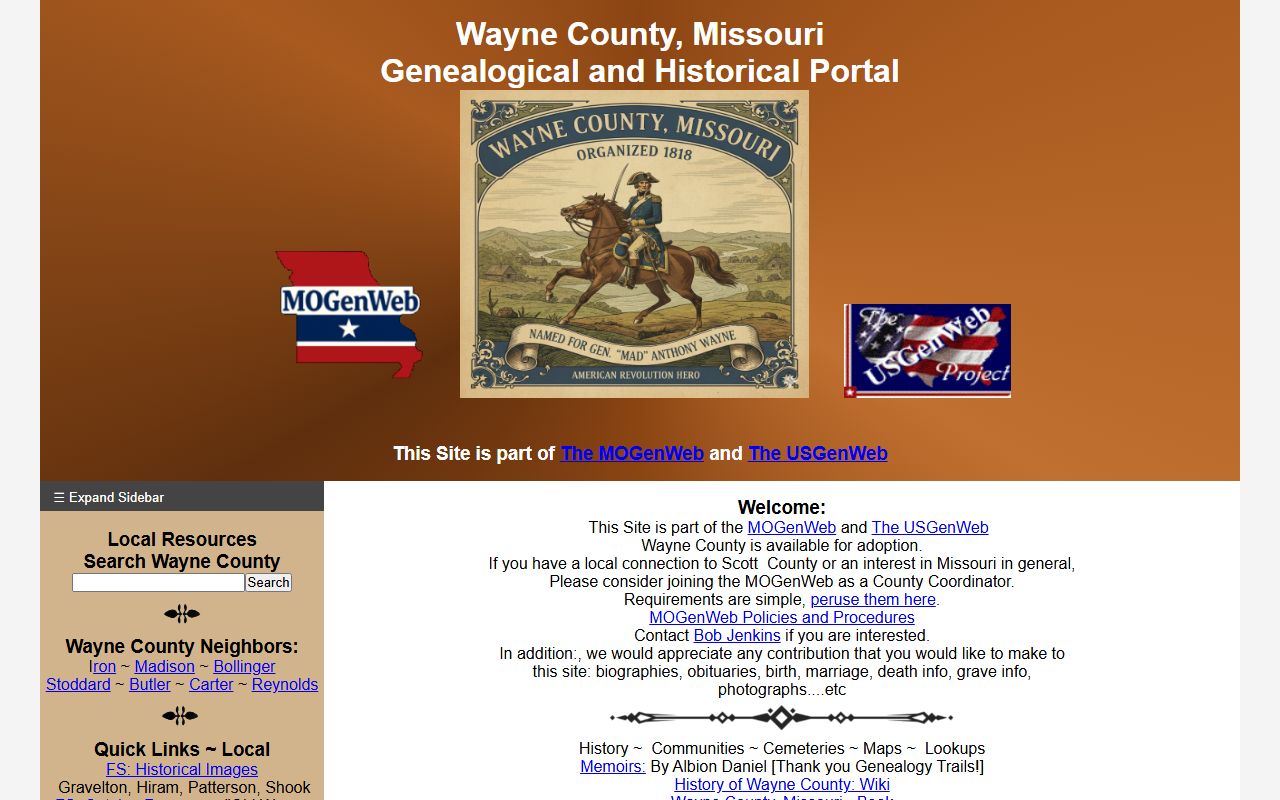
MOGenWeb pages for counties with courthouse fire losses like Wayne often include research guides for working around record gaps.
The National Archives at Kansas City, at the intersection of I-70 and the Missouri River, holds federal land entry records and naturalization records that can substitute for missing Wayne County courthouse files. Federal census records for Wayne County from 1820 through 1940 are indexed on FamilySearch and Ancestry. The 1820 census is the earliest for this county and names heads of household only. From 1850 onward, every household member is named with age and birthplace. These records become the primary source for ancestors whose marriage, probate, or court records were lost in the courthouse fires.
Online Records for Wayne County
Missouri Digital Heritage holds death certificates from 1910 to 1969, pre-1910 birth and death records, land records, and military records for Wayne County. No account or fee is required. The Missouri State Archives holds microfilm of Wayne County records and can help identify what survived the fires and what is available for the post-fire periods.
FamilySearch at familysearch.org holds all available federal census records for Wayne County from 1820 through 1940. For the fire-loss periods, census records, mortality schedules, and federal land patent records on the General Land Office database at glorecords.blm.gov are the primary substitutes. These three free sources together can often establish family relationships that would normally come from courthouse records. The State Historical Society of Missouri also holds microfilm and manuscript collections for southeast Missouri counties including Wayne.
The Missouri State Genealogical Association publishes guides on researching in counties with courthouse losses. For Wayne County specifically, their resources on working around fire-loss record gaps are useful before starting any systematic search.
Note: Marriage records begin in 1853 rather than 1818 due to the first courthouse fire. Land records from 1818 have some gaps and re-recordings from the same fire and the 1892 fire.