
Search Newton County Genealogy Records
Newton County genealogy records date from 1839 and are maintained at the Recorder of Deeds and Circuit Clerk offices in Neosho, Missouri. Researchers should know that the Newton County courthouse burned during the Civil War in 1863, and some early records were destroyed. What survived, along with records created after the fire, is held at the courthouse today. The Neosho Newton County Library and the Newton County Historical Society provide additional research support for families tracing roots in this southwest Missouri county.
Newton County Quick Facts
Newton County Recorder of Deeds
The Newton County Recorder of Deeds is at 101 S. Wood St., Neosho, MO 64850. The phone number is 417-451-8237. Marriage records and land records begin in 1839, when the county was organized from Barry County. The courthouse fire of 1863 destroyed some records from the earliest years of the county, so there may be gaps in certain document series from 1839 through the Civil War period. Records created after the fire are generally intact and accessible.
For genealogists researching Newton County families, marriage licenses are often the most useful records at the Recorder's office. They name both parties, give a precise date, and in some older records list witnesses or parents. Land records here trace property ownership from the 1840s onward and can help identify family relationships when land passed between relatives. Warranty deeds, quitclaim deeds, and deeds of trust are all part of the land record collection.
Standard recording fees are $24 for the first page and $3 for each additional page. Copies of recorded documents cost $1.00 per page. Marriage licenses require both parties to appear in person with valid photo ID and a Social Security number. The fee is $46.00 and the license is valid for 30 days anywhere in Missouri. The office is open Monday through Friday; call 417-451-8237 to confirm current hours.
Note: Because the 1863 courthouse fire may have destroyed some pre-war records, alternative sources like church registers, census records, and federal land patents become especially important for Newton County research before 1865.
Newton County Circuit Court and Probate Records
The Newton County Circuit Clerk handles all court records for the 40th Judicial Circuit. Court and divorce records begin in 1839, and probate records begin in 1843. As with all courthouse records here, some early files may have been lost in the 1863 fire. Records from the post-war period through the present are generally complete. The Circuit Clerk's office is the place to look for divorce filings, civil case records, and the probate files that document an ancestor's estate, listing heirs by name and describing assets.
Probate records are among the most valuable documents for family researchers. When an ancestor died owning property, the probate court required an accounting of assets and a distribution to heirs. Those records name spouses, children, and sometimes grandchildren, making them a key source for tracing family structures in Newton County. Probate files from the late 1800s through the early twentieth century are particularly likely to survive intact here given the wartime loss of earlier records.
Cases filed on or after November 12, 2003 can be searched free online through Missouri Case.net. Older records require an in-person visit to the Neosho courthouse. The Circuit Clerk's office can help you identify finding aids for older files and let you know what is available for specific time periods.
Note: Juvenile records are sealed under Missouri law and are not available through genealogy research requests.
Vital Records for Newton County
The Newton County Health Department holds birth certificates from 1920 onward and death certificates from 1980 onward. For records outside those ranges, the Missouri Bureau of Vital Records at 930 Wildwood Dr., Jefferson City processes statewide requests. The phone number is (573) 751-6387 and certified copies are $15.00 each. Birth and death records collected by the County Clerk between 1883 and 1892 exist for some years, though reporting was inconsistent during the early years of statewide registration requirements.
The free online death certificate database at Missouri Digital Heritage covers Newton County death records from 1910 to 1969. The database holds over 9 million statewide records indexed by name and searchable at no cost. Images of the original death certificates are available online. For Newton County deaths between 1910 and 1969, this is the fastest way to locate a record without contacting the Bureau of Vital Records. The image includes informant information, cause of death, and sometimes place of burial.
For birth records before 1910, church registers and family bibles are the primary substitutes. The Neosho area has a long history of Baptist and Methodist congregations, and some church records go back to the mid-1800s. The Newton County Historical Society or the Neosho Newton County Library may know which local churches have preserved early registers.
Newton County Libraries and Historical Society
The Neosho Newton County Library at 201 W Spring St, Neosho, MO 64850 provides genealogy research support for Newton County families. The phone number is 417-451-4231. The library offers access to major genealogy databases including Ancestry Library Edition and HeritageQuest Online, plus local newspaper microfilm and a genealogy reference collection. Staff can assist with research questions and help navigate the library's holdings for Newton County records. In-library access to premium genealogy databases is free to any library patron.
The Newton County Historical Society at 121 N Washington St, Neosho, MO 64850 maintains a genealogy collection that complements the courthouse records. Their phone number is 417-451-4940. The Society holds family histories, cemetery transcriptions, local photographs, and records donated by researchers over the years. For anyone researching the Civil War period in Newton County, the Society's collection may also include military records, pension files, and wartime documents that illuminate the lives of ancestors who lived through that difficult era.
The Newton County MOGenWeb page provides free access to transcribed records and family history contributions from volunteer researchers.
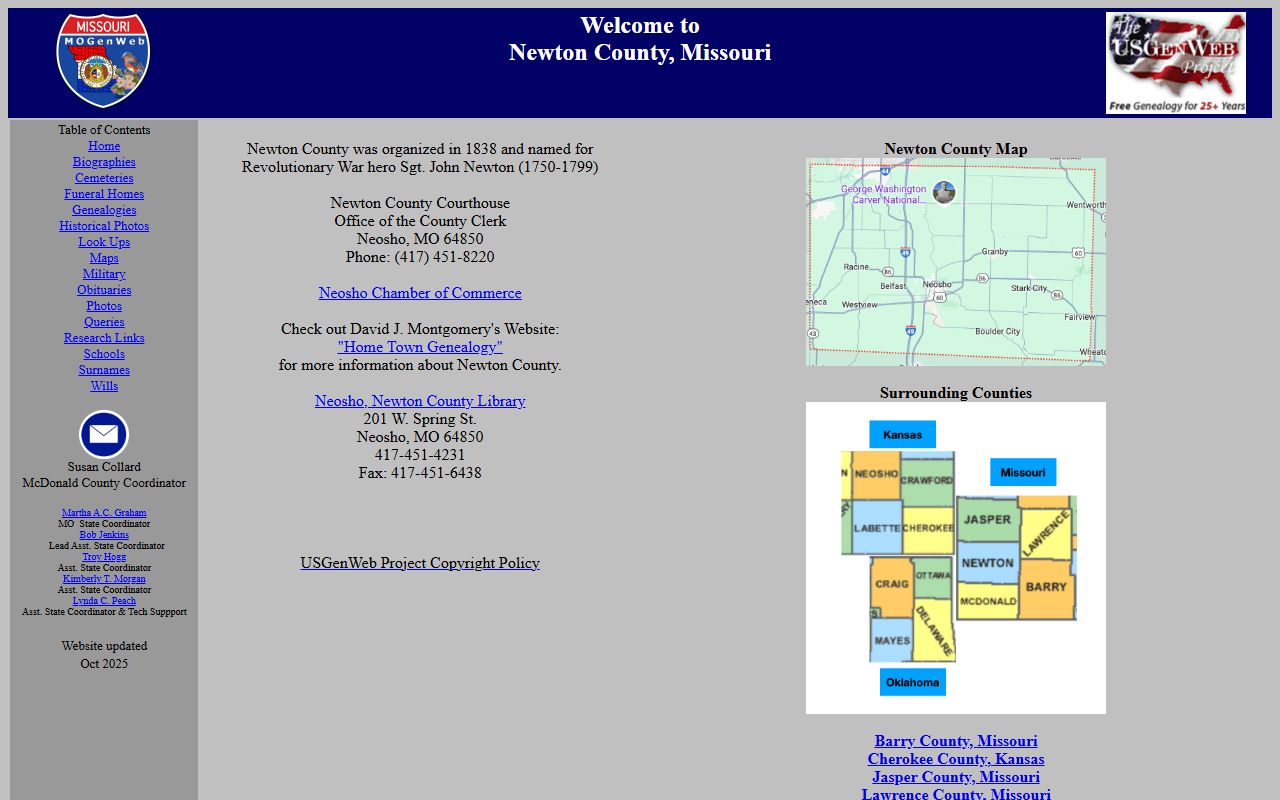
MOGenWeb volunteers often have transcribed records from the years surrounding the 1863 courthouse fire, which can help fill gaps in the official record set.
The Ozarks Genealogical Society is a regional resource that covers Newton County along with much of southwest Missouri. They maintain a library and research services in Springfield and can assist with queries related to Newton County families.
Online Genealogy Resources for Newton County
Several free online databases hold Newton County genealogy records. Missouri Digital Heritage has death certificates from 1910 to 1969, pre-1910 records where they survive, land records, and military documents. No login or fee is required. FamilySearch at familysearch.org has indexed Newton County census records from 1850 through 1940 and some court and probate records. It is always free and is usually the best first stop for any Missouri county search.
The Missouri State Archives holds microfilm of Newton County records and has research guides to help identify what survived the 1863 fire and what is available for each time period. Staff can help you identify specific films to request. Federal census records from 1850 through 1940 are indexed on FamilySearch and Ancestry. Because the 1890 census was largely destroyed nationally, the 1880 and 1900 censuses are the key sources for that period in Newton County.
The Missouri State Genealogical Association connects researchers statewide and can direct you to Newton County-specific resources. The State Historical Society of Missouri holds newspaper archives for Newton County that may include obituaries and other genealogical information from the late 1800s and early 1900s.
Note: Given the 1863 courthouse fire, census records, church records, and the published 1888 county history become especially critical tools for Newton County research covering the pre-Civil War period.